District 20 · Land & Pricing
Thomson Reserve and the Record Sin Ming Land Bid: What D20 New Launch Pricing Looks Like in 2027
A developer just paid a record $1,612 psf ppr for a plot two MRT stops from Thomson Reserve. It does not change Thomson Reserve's price sheet — but it does tell you what the next District 20 launch has to charge, and that is the number worth comparing against.
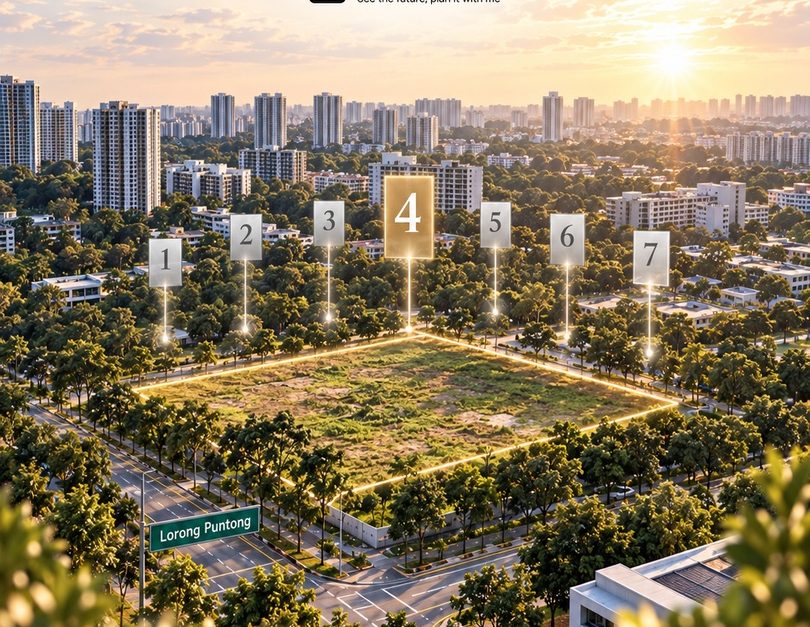
What actually happened
The Urban Redevelopment Authority's government land sale tender for the Lorong Puntong site in the Bishan planning area closed on 15 September 2026. Eco World Development submitted the top bid at $208.1 million, which works out to $1,612 per square foot per plot ratio — a record for a pure-residential site in the Rest of Central Region.
| Site | Lorong Puntong, Bishan planning area (District 20) |
|---|---|
| Site area | About 46,103 sq ft |
| Maximum gross floor area | About 129,093 sq ft |
| Expected yield | About 140 private homes |
| Winning bid | Eco World — $208.1 million, or $1,612 psf ppr |
| Bids received | Seven |
| Gap to second place | 11.1% above $187.33 million ($1,451 psf ppr) |
| Previous RCR pure-residential record | $1,515 psf ppr — Berlayar Drive, August 2026 |
The second-highest bid came from Intrepid Investments and TID Residential. Seven separate developers ran seven separate feasibility studies on this pocket of District 20 and all of them decided it was worth competing for.
The first thing to be clear about: this is not Thomson Reserve's land
It is worth stating plainly, because the two get conflated. Thomson Reserve sits on a separate site at Bright Hill Drive, acquired at a different time by UOL Group and CapitaLand Development. Its price sheet will be built from its own land cost, its own construction contract and its own financing — not from what Eco World paid in September 2026.
So the record bid does not push Thomson Reserve's price up. What it does is set a reference point for every District 20 launch that comes after it, and that reference point is useful to any buyer currently shortlisting in this catchment.
A land bid does not reprice the project next door. It prices the project that has not launched yet.
From land price to launch price: the arithmetic
A developer's breakeven is never the land price alone. It is land plus construction, financing through the build, professional fees, marketing, agent commissions, and the cost of carrying unsold stock against development charge timelines.
On a small, high-specification site, that stack has generally been running in the region of $800 to $900 psf in recent projects. Add it to $1,612 and breakeven lands somewhere around $2,400 to $2,500 psf. Developers do not build at breakeven, so a normal margin puts an indicative launch range in the high $2,000s to low $3,000s. Some analysts have publicly floated $3,000 to $3,100 psf.
Treat that as a range, not a forecast. Product mix, unit sizes, the state of the market in 2027 and 2028, and how hard the developer chooses to push all move it. A record land bid makes a high launch price likely. It does not make it certain.
Why this matters to a Thomson Reserve shortlist. When Thomson Reserve's price sheet is released, you will have a live, transactable number in District 20. The Sin Ming figure above is a projection for a project that has not launched. Comparing a real price against a projected one is the single most useful exercise available to you right now — and most buyers never do it because the projected number is the one that makes headlines.
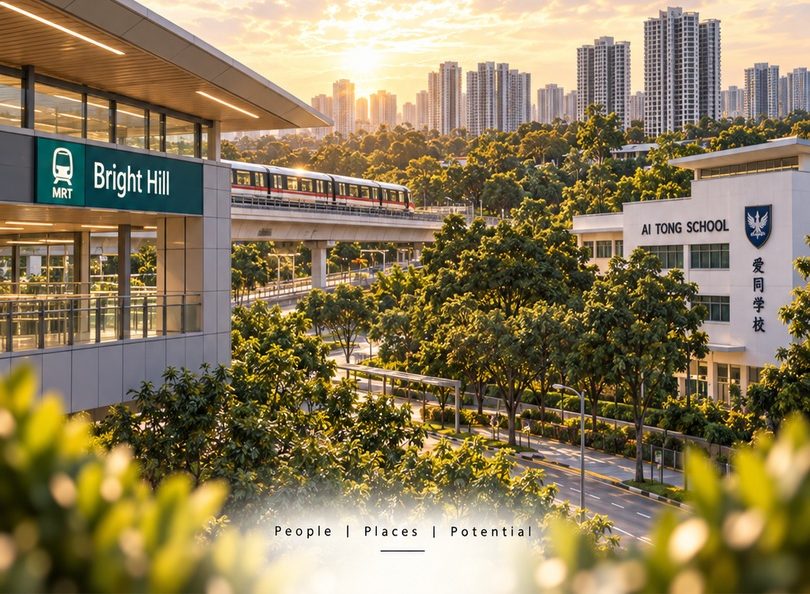
What the bidders were actually paying for
Three things do the work in this pocket of District 20.
The interchange
Bright Hill on the Thomson-East Coast Line is planned as an interchange with the Cross Island Line. A two-line station changes the commute maths for a much wider set of buyers than a single-line one, and that upgrade is already committed rather than speculative.
The school catchment
Ai Tong School anchors the area for families who plan around primary one registration. School-driven demand is unusually price-insensitive and unusually durable, which is exactly the kind of demand a developer wants underwriting a launch.
The scarcity
Bishan and the Sin Ming stretch have seen little new private supply. The surrounding fabric is low-rise and stable, so a new project does not have to compete with a wall of comparable new stock going up beside it. That is the condition under which seven developers show up for one small plot.
Small project versus large project: an actual trade-off
About 140 units is a fraction of the 500 to 1,000-unit launches most buyers have got used to. Thomson Reserve, at 1,268 homes, sits at the other end of the same spectrum. Neither is better in the abstract; they trade different things.
| Small project (~140 units) | Inventory clears without deep tail-end discounting, which supports pricing. But fixed costs spread over fewer units, the facilities deck is modest, and monthly maintenance per unit is usually higher because the same pool, gym and management contract are shared among fewer owners. |
|---|---|
| Large project (~1,268 units) | Fuller facilities, lower maintenance per unit, and a deeper pool of future resale buyers who know the project's name. But you compete against your own neighbours on the way out, and the developer has more inventory to move if the market softens. |
If you are comparing a future Sin Ming launch against Thomson Reserve, compare the maintenance fee estimate as carefully as you compare the psf. Over a ten-year hold, the difference is not trivial.
The check most buyers skip: the resale gap
Before you decide any launch in this catchment is attractive, price the alternative. The comparables to pull are the newer projects in the same stretch — Thomson Three, Thomson Impressions, and the Bishan stock around Sin Ming Avenue.
Do this yourself rather than taking an agent's summary, including mine. Pull the last twelve months of caveats from URA's residential transaction search, filter by project and by unit size band, and work out the median transacted psf for the layout you actually want. Then compare that figure against the indicative launch range above.
A new launch will always command a premium over nearby resale. That premium pays for a new lease, a new building, and the option to buy before completion. Historically, a gap of roughly 15 to 25 per cent over comparable newer resale has been digestible. When the gap stretches toward 40 per cent or more, you are no longer paying for the location — you are paying for newness, and newness is the one thing that depreciates from the day you collect keys.
Four checks before you commit to anything in District 20
1. Entry price against the resale gap
Not against the last new launch elsewhere in Singapore. Against what the same catchment transacts at today.
2. Layout efficiency, not just psf
The difference between an efficient 700 sq ft two-bedder and an awkward one is most of your liveable space. Ask for the floor plate.
3. Competing supply in your exit window
Count what else can launch in this catchment before you plan to sell, including sites still in the government land sale pipeline. The Lorong Puntong site is now one of them.
4. Your exit buyer pool
At a high entry price, who buys it from you in seven years, and what will they be comparing it against?
What I would actually do now
If your timeline is inside the next 18 months, work with the price sheets that exist. Thomson Reserve previews in Q3 2026 and will give you a real District 20 number to test against resale. The Sin Ming project is a projection with no launch date attached.
If your timeline is genuinely flexible and you are buying on value rather than need, there is no cost to waiting until both price sheets exist and comparing them properly. Just be honest about which of the two you are — most buyers who say they are waiting are actually buying, eventually, at a worse price.
Sources: URA government land sale tender results for the Lorong Puntong site, September 2026, and contemporaneous market reporting on the tender outcome. Bid figures, site area and yield are as published at tender close. Launch-price ranges are indicative estimates, not quoted prices. Thomson Reserve unit count, developer and preview timing are developer estimates and may change until official launch.
Frequently asked questions
How does the Sin Ming land bid affect Thomson Reserve pricing?
Not directly. Thomson Reserve sits on a separate site acquired at a different time by UOL Group and CapitaLand Development, so its price sheet is set by its own land and build cost, not by the Lorong Puntong tender. What the record bid does is set the pricing expectation for the next District 20 launch. A land cost of $1,612 psf ppr plus typical build and financing costs implies a breakeven near $2,400 to $2,500 psf for that future project. Any launch priced below that range in the same catchment is comparatively better value on entry price.
What is the difference between Bright Hill and Upper Thomson MRT for a buyer?
Both are Thomson-East Coast Line stations one stop apart. Bright Hill is planned as an interchange with the Cross Island Line, which will eventually give it two lines. Upper Thomson is a single-line station today but sits in a denser, more established retail stretch. The interchange is a longer-dated benefit; the retail and amenity depth around Upper Thomson is available now.
How many units will Thomson Reserve have?
Thomson Reserve is planned at 1,268 homes across 2 to 5 bedroom layouts, developed by UOL Group and CapitaLand Development, with a preview expected in Q3 2026. That is a large project by current standards, which usually means a fuller facilities deck and lower maintenance cost per unit than a small development, but also more competing stock in your own catchment when you eventually sell.
Should I wait for the new Sin Ming launch instead of buying in Upper Thomson now?
The Lorong Puntong site is expected to yield only about 140 homes and will not launch for some time, so waiting means holding out for a small project at a price that is currently only an estimate. If you are buying to live in within the next 18 months, a live price sheet you can transact on is worth more than a projected range. If you are buying purely for value and your timeline is flexible, it is reasonable to wait and compare the two when the second price sheet exists.
Is District 20 considered Rest of Central Region?
Yes. District 20, covering Bishan, Sin Ming, Thomson and Ang Mo Kio, sits in the Rest of Central Region under URA's market segmentation. That matters because RCR benchmarks, including the previous pure-residential land record of $1,515 psf ppr at Berlayar Drive in August 2026, are the right comparison set for pricing a District 20 launch.
Want the actual District 20 numbers?
Tell me your budget and timeline. I will pull the transacted psf for the Thomson and Bishan comparables so you can see the gap for yourself before any price sheet lands.
Chat on WhatsAppIsaac Lee · PropNex Realty Pte. Ltd. · CEA R043955C / L3008022J. Information on this page is general in nature, does not constitute financial advice or an offer, and is subject to prevailing regulations and your own due diligence.